ADDITIONAL INFORMATION
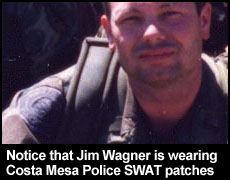
Jim Wagner on the Costa Mesa Police S.W.A.T. team
In 1993 I saw a flyer on the bulletin board in my police station. It was a vacancy for a S.W.A.T. officer. Vacancies on the Costa Mesa Police S.W.A.T. team were rare since we only had 165 sworn police officers. S.W.A.T. is an acronym for Special Weapons And Tactics. Most team members typically stayed on the team anywhere from five years to ten years. Ever since my first days in the police academy I knew that I wanted to be on the S.W.A.T. team. I figured that my chances of getting onto the team were good, because I had set up a few realistic scenarios for the team when I was a Custody Officer working in the jail. When my opportunity came I tried out for one of the two open slots, as did a dozen other "alpha dogs." I remember the day vividly, because the S.W.A.T. Physical Agility Test was on my 30th birthday, and my wife had a huge party planned for me at my martial arts school that I owned and operated on the side – The Academy of Fighting Arts.
The day of my testing was a sizzling breezeless July day, and the test did not get underway until late morning, which meant that the coolness of the morning had long disappeared to the Southern Californian sun. None the less, I was energized and I scored high on everything. I did my 10 pull ups on the chin up bar. I dragged the 170 pound dummy 40 feet. I did my 60 push-ups and immediately rolled over to do my 60 sit-ups to get maximum points. I ran around the one-minute-or-less obstacle course leaping the walls like a gazelle, and weaved myself around the pylons like going through like a slalom ski course in 56 seconds. If this were not enough, we applicants had to run up a flight of stairs, three stories high within 15 seconds, and ring a bell mounted at the top of the banister. Then, to finish the testing, we had to run a mile and a half on the cooking rubberized track. I hate long distance running. I hated running in the Army, I hated running in the Police Academy, and I dreaded it just as much on the day of the S.W.A.T. test; especially timed runs. However, I ran my heart out. Unfortunately, I was 40 seconds too slow according to the examiner. He looked at me, and said unemotionally, 'Sorry, you didn’t make it.' I shook my head in acknowledgement, found myself a park bench in the shade, and then let the heat slowly evaporate from my body. Fortunately, my birthday party that night lifted my spirits. I knew that I'd try again when the opportunity presented itself.
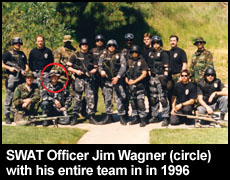
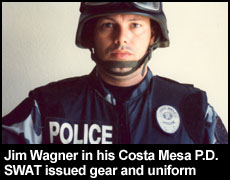
A S.W.A.T. position opened up the following year, and it was for only one slot. This time I was determined to push myself harder on the mile and a half run, and I crossed the finish line under the allotted time. I went on to pass the rigorous shooting test conducted by Range Master John Burgner, which consisted of a hostage situation using projected images on a live-fire screen. A few weeks later I sat across the desk from Lieutenant Ron Smith, the new S.W.A.T. commander, and he handed a silver plated S.W.A.T. badge for to be worn on my patrol uniform. He said to me, "Welcome to the team. You’re in." Next, the lieutenant handed me an equipment list that I took down to the Property Division where I was issued a Kevlar helmet, black Battle Dress Uniform, boots, tactical vest, and the whole kit. After only two years and nine months as a patrol officer, and two years as a corrections officer before that, I was officially on the Costa Mesa S.W.A.T. team beginning March 11, 1994. I served for three years, two months, and 13 days. On May 24, 1997 I resigned from the team, and I was awarded a SW.A.T. plaque for my service, which is given only to those who have served honorably on the team. The award was approved by S.W.A.T. Commander Ron Smith and presented by my first Field Training Officer, and fellow S.W.A.T. Officer, Phil Myers.
As I had mentioned before, years before being placed on the S.W.A.T. team I had set up realistic training scenarios for the S.W.A.T. team. This direct contact with the team gave my the opportunity to learn their tactical techniques and training methods long before I was required to learn them. I had also been training heavily with outside military units and law enforcement agencies, mostly at Camp Pendleton and surrounding areas since 1992, and I was even being asked to instruct defensive tactics and tactics courses outside of my own department. This gave me many innovative organizational and training ideas, which I shared with the new S.W.A.T. commander Lieutenant Ron Smith, who had replaced Lieutenant John Fitzpatrick. It was Lieutenant Fitzpatrick that first utilized my tactical diagramming skills during a S.W.A.T. call-out, even though I was just a patrol officer at the time. The LT has me take up a position normally for someone on the S.W.A.T. Perimeter Team when an entry into the suspect's apartment was inevitable. Lieutenant Smith was keen on my many ideas, and he was instrumental in my Special Operations career.
|
As a S.W.A.T. officer introduced a wide variety of concepts and skills to the team, and an entirely new position was created just for me – Command Post Operations Officer (CP OPS OFC). Typically most Costa Mesa SWAT members had to start on the Logistics team. Lieutenant Ron Smith wanted me crossed trained in all disciplines: Logistics, Crisis Negotiation Team, Sniper, Entry, Intelligence, and Command Post. As Lieutenant Ron Smith put it to me, “I want you to be my right hand man. I want to make sure that in an actual call-out that all information is coming through to me in a well organized manner.” That was my specialty - teaching people, and making systems work better.
My responsibilities as the Command Post Operations Officer included:
1. Reconnaissance – gather intelligence information (by means of observation, tactical sketches and photography) without detection in the Kill Zone.
2. Initial Planning & Coordination – provide the S.W.A.T. commander and Intelligence Officer, who was Detective Greg Scott at the time, with information gathered at the Kill Zone to aid them in identifying required actions for the mission.
3. Security Element – provide security at the Command Post (CP) or in critical areas when assigned.
My primary duty was to be the first officer to scout out the target area, gather intelligence, and then create the tactical diagrams that would be later used by the entire team. The S.W.A.T. commander would use the tactical diagrams for decision making and the Entry Team would study them before making forced entry. Of course, good intelligence gathering and accurate tactical diagrams are vital for the safety of the Entry Team. It’s not merely drawing a few lines on paper, but a good operator must understand what the interior layout is based upon vents, chimneys, ventilation pipes, windows, et cetera. The discipline is also about knowing wall structures, door types for breaches, and obstacles and barricades. One of the courses Lieutenant Ron Smith sent me to, in order to properly perform my duties, was INTRODUCTION TO TACTICAL DIAGRAMMING presented by the National Tactical Officers Association (NTOA) taught by Deputy Tom Lambrecht on March 19, 1997 at the 13th TREXPO Conference on Special Tactics & Security.
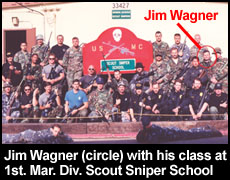
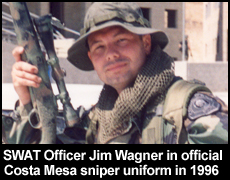
This unique position required that I be trained in scout sniper skills. I first got my training in-house, and then later on with Scout Sniper School with Division Schools with the 1st Marine Division at MCB Camp Pendleton, California. For a S.W.A.T. call-out I was required to have a ghillie suit at the ready, and all sniper equipment required for scouting. Although I was trained on the Remington 700 police sniper rifle (.308), and M-16 assault rifle (5.56 mm), I was armed with a Smith & Wesson model 642 .45 caliber semi-automatic pistol for self-defense should a suspect engage me while in close proximity to the target. On call-outs I was also subject to be placed in whatever position that was needed.
|
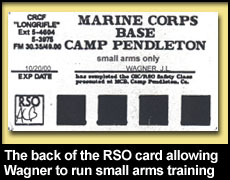
When I received the Range Safety Officer (RSO) certification from the U.S. Marine Corps I was authorized to run and supervise live-fire sniper, rifle, and pistol range training on various ranges at MCB Camp Pendleton.
|
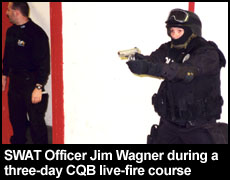
As a S.W.A.T. officer I was authorized by my command to attend Close Quarter Battle (CQB) courses and hostage rescue courses with outside law enforcement agencies and military units. I regularly trained on the MP5 submachine gun, the M-16 assault rifle, shotgun, and pistol. On two occasions I, a patrol officer using my S.W.A.T. skills, would be the point-man on two different hostage rescues while on police patrol when there was not enough time to call out the S.W.A.T. team. The Costa Mesa Police Department did not have a full time team, but members where called out when there was an emergency or for training. On both occasions forced entry was made by me, and both ended satisfactory. (Report number 97-37340 occurring on October 11, 1997, and the second incident I failed to get a copy of the report).
Working closely with the Entry Team, I met with Lieutenant Goyen of the United States Army Special Operations Command South IMA Detachment 697 on May 9, 1994 to get the latest information on bus entry techniques and tactics that the Army had developed (a tactical situation law enforcement agencies were focusing on at the time). During the meeting Lieutenant Goyen gave me tips on sniper tactics involving bus situations, hostage negotiations strategies, and Security Operations (SECOPS). I had trained with Lt. Goyen, and members of his team, in sniper tactics in Victorville, California on March 20th and 21st, 1994. Shortly after this fact finding mission I met with Pam Peters of the Orange County Transit Authority (OCTA) to get bus specifications on all of the public transportation buses of Orange County (OC). Pam Peters was also a Reserve sergeant with the Orange County Sheriff’s Department Search & Rescue Unit (SRU), and she would later convince me to join her department when I left the Costa Mesa Police Department in 1999.
On March 15, 16, and 17, 1994 I attended a course titled Managing Hostage and Barricade Situations in Burbank, California taught by Ronald M. McCarthy. Ron McCarthy was well known in the United States law enforcement community at the time; he was a pioneer of tactics. He had served as a Los Angeles police officer for 24 years, and was with Metro Division (S.W.A.T.) for 20 years working, and worked his way up to the position of Assistant Commander in 1984. From 1984 to 1986 Ron McCarthy was the Chief of Tactical Operations for the U.S. Department of Energy. I also attended the Security Site Survey taught by Steven Mattoon and Greg Bartol. There are a lot more disciplines to Special Operations than just shootin' and movin'.
The S.W.A.T. Negotiations Team called upon me to run some realistic scenarios from time to time. I needed to know their job inside and out, because the information from them on a real call-out had to go to the Command Post, and understanding the information dissiminating the information to the different team elements was literally life and death. I enjoyed getting a fare amount of training in this field.
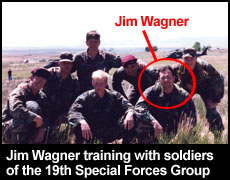
I also worked closely with the S.W.A.T. Intelligence Officer, and I was sent to a few courses in this specialty. I also had the opportunity on more than one occasion to work with the U.S. Army 19th Special Forces Group Military Intelligence Detachment.
|
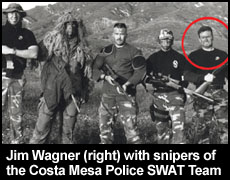
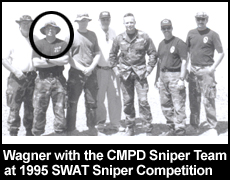
On August 14, 1995 I was one of several S.W.A.T. officers representing the Costa Mesa Police Department S.W.A.T. Sniper Team for the 12th Annual Fullerton Police Department “GROUP THERAPY” SWAT Sniper Competition held at the San Gabriel Valley Gun Club in Los Angeles; an event organized and directed by Officer Neal Baldwin of the Fullerton Police Department. Officers on the team included Sergeant Dale Birney, Officer Graham Beilby, Officer Dan Erber, Officer Darrell Freeman, and range master advisor Jack Sharnhorst for U.S. Army Vietnam veteran. I, along with my shooting partner, was awarded a certificate as one of the TOP TWENTY SHOOTERS in the State of California. For the competition I used a Remington 700 police sniper rifle using a 10x scope. Officers Dan Erber and Darrell Freeman ranked 3rd in the state. 70 law enforcement and military snipers from all over the State of California participated in this competition.
|
Like all S.W.A.T. officers I was required to know every piece of equipment, and every inch of the Mobile Command Post, and as such I had to work closely with the Logistics Team; everything from weapons storage to setting up gas powered generators and portable lights.
Of course, I had to master Command Post Operations and be able to communicate and coordinate with all S.W.A.T. elements. For this specialty I was sent to a tactical diagram course, an Identi-Kit course by Smith & Wesson, and various crisis management courses. I not only knew S.W.A.T. operations from the operator’s perspective, but from a command perspective as well, which game me a tactical background that few other officers ever receive. Of course, some a lot of this knowledge, techniques, and tactics found its way into the Jim Wagner Reality-Based Personal Protection system.
|
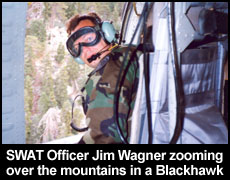
I also had the opportunity to work with the my department's Aviation Unit going up in the Hughes 500 police helicopter to do aerial photographs of the city of Costa Mesa (a time before Google Earth). I was also trained in air assault tactics by U.S. Customs Aviation in Sikorsky UH-60 Blackhawk helicopters at March Air Force Base in early 1993. The second training was a helicopter flight from March AFB, over Big Bear in the mountains, and then some desert drop offs just beyond the mountain range. Then on September 22nd and 23rd, 1993 I supervised air operations training for various law enforcement agencies through my company HSS International, Inc.
|
My last S.W.A.T. call-out was in 1997 when the Costa Mesa Police S.W.A.T. team surrounded an apartment building in the 500 block of Hamilton Street in Costa Mesa where six men, Mexican smugglers known as “coyotes” were holding 12 illegal immigrants hostage at gunpoint. I was assigned at the Command Post serving Lieutenant Ron Smith. The incident was over rather quickly when the suspects told the S.W.A.T. negotiators that they were willing to surrender. Mark Avery of the Orange County Register (the local newspaper) took a photograph of the two suspects being led away in handcuffs from the apartment that had been rented to Miguel Cetendo.
Looking back on my three-year S.W.A.T. career was where I first had the opportunity to use a wide variety of my tactical and organizational skills, thanks to a few of my supervisors, especially Lieutenant Ron Smith who I looked up to as one of my mentors. I was the most cross trained person on the S.W.A.T. team, which did cause some friction with some of my fellow team members, but it gave me the experience and skills that I would use later to train other units and agencies.
Most people make the mistake, especially civilians, of thinking that S.W.A.T. is more dangerous than patrol, and sometimes it can be. However, the average street cop in a big city experiences violent situations as they unfold or when crimes are in progress. Such situations are usually much more fluid and unpredictable. By the time a S.W.A.T. team arrives, in many cases, the situation is contained by a police perimeter and a S.W.A.T. Entry Team goes in for a surgical strike. However, statistically most suspects surrender before an Entry Team goes in, or before a sniper is authorized to take his shot, because they know that eventually the S.WA.T. team will win and control the situation. As a police patrol officer I have been in dozens of life and death situations, and I give my S.W.A.T. training credit for making me a better police officer, and then a better deputy Sheriff, and then a better United States Federal Air Marshal, and then a better soldier, and even a better private security office. Obvioulsy, my S.W.A.T. background made me a better civilian self-defense instructor.
|
|
|